
SaaS
The design overhaul that eliminated an estimated $30K in hidden friction and reduced the process time from hours to just 15 seconds.


Ansarada
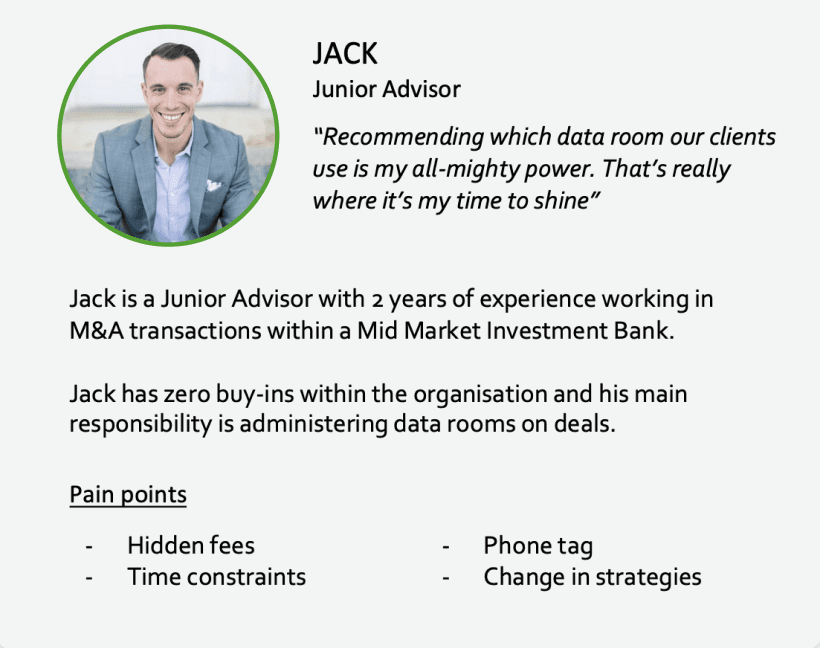
1 Product Designer
5 Backend Developers
3 Front End Developers
1 Product Manager
1 Data Analyst
1 Researcher
I architected and executed the global design strategy for Ansarada’s Growth engine, driving platform scale through a high-velocity experimentation framework. I held end-to-end accountability for the commercial funnel, re-engineering purchase journeys and paywall logic to eliminate friction and maximise conversion rates.
Challenge
Financial Advisors in high-stakes M&A environments need to move with absolute speed and clarity.
Ansarada’s legacy quoting process functioned as a significant conversion barrier. The workflow was heavily sales-dependent, creating a "dead end" that obstructed user autonomy and slowed transaction velocity.
Results
The redesign of Ansarada’s quote process replaced a stagnant, manual system with a high-velocity, self-service experience. By prioritising transparency and user autonomy, the new design improved efficiency for users and increased business conversions.
Velocity Bottleneck
3hrs + 14min
Medium Completion Time Of
Conversion Leakage
26.3%
Overall User drop off rate
Research
The primary goal of the research phase was to precisely map the Financial Advisor's workflow and quantify the pain points within the legacy quote process. By combining quantitative data audits with qualitative interviews, I uncovered that the existing system was built for sales control rather than user speed.

Quantitative Analysis
Using funnel analytics and a data audit, I pinpointed exactly where momentum was lost
The 3-Hour Barrier
Data revealed a median completion time of 3 hours and 14 minutes from the start of a quote to completion, largely due to manual hand-offs and system delays.
Conversion Baseline
Initial analysis showed only a 54% completion rate once a user entered their email, highlighting a significant opportunity for optimisation.
The Profile Drop-Off
The "Profile Screen" was identified as the single largest point of friction, with 26.3% of users abandoning the flow at this specific stage.
Qualitative Insights
I conducted interviews with Financial Advisors and held stakeholder workshops to understand the human cost of these delays.
Reputation over Records
Advisors reported that their reputation depends on immediate responsiveness; a 3-hour wait for a quote meant they couldn't provide instant answers to clients during high-stakes negotiations.
The "Screenshot" Workaround
I discovered that 95% of visitors dropped off because they didn't need a formal PDF emailed to them; they simply wanted pricing transparency to screenshot or copy-paste into their own pitch decks.
Transparency Anxiety
Advisors were often "browsing" and were unsure which plan they needed (e.g., data limits or duration), leading to a "dead end" experience when forced into a formal commitment.
Design
The primary goal of the research phase was to precisely map the Financial Advisor’s workflow and quantify the pain points within the legacy quote process. By combining quantitative data audits with qualitative interviews, I uncovered that the existing system was built for sales control rather than user speed.

Step 1 (Before)
High Cognitive Load: A dense grid forced advisors to manually cross-reference 25+ data points to find a single price.
Static UX: The table functioned as a fixed image rather than an interactive tool, offering no real-time feedback.
Visual Clutter: Excessive “Contact Us” buttons and
secondary data obscured the primary conversion path.
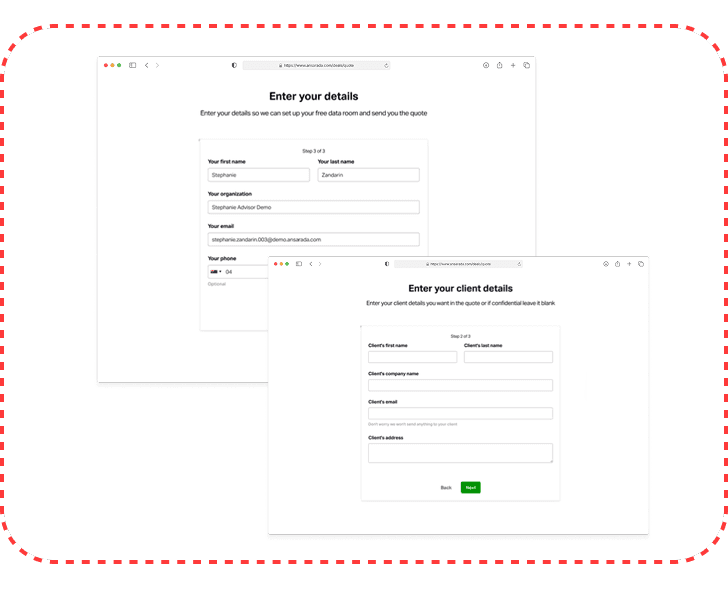
Step 2 + 3
Premature Friction: Sensitive client details were requested before providing value, creating a major trust barrier.
Linear Roadblocks: A rigid sequence without “skip” options led to a 26.3% drop-off rate.

Step 4 (Before)
Verification Fatigue: Forced advisors to manually review dense data fields, slowing down deal speed.
Passive Layout: Acted as a static receipt rather than an interactive tool for final adjustments.
Hierarchy Gaps: Lacked visual emphasis on key quote variables, increasing the effort required to verify details.

Step 5
Zero Momentum: Provided no immediate “Next Step” to keep the user in the product.
Stalled Workflow: Replaced active deal-making with a “Check your email” prompt, creating a functional roadblock.
Value Disconnect: Failed to provide an instant download or a sample quote to reassure the user.
MVP definition
Defining the MVP
We defined the MVP as the “Instant Quote + Free Data Room Setup” feature, which delivered the core value proposition — speed and risk mitigation — first, deferring complex billing integration to Phase 2.

Self-Service Configuration
Replaced a static, manual system with an interactive configurator for instant deal speed.
Real-Time Price Transparency
Provides a live quote that updates as users toggle data and timeframe options.
Reduced Cognitive Load
Simplified a complex 25+ data point grid into three intuitive, sequential steps.
Global Accessibility
Integrated a global currency selector to cater to international advisors seamlessly.
Enhanced Mobile Experience
Designed a responsive, mobile-first interface to allow advisors to generate quotes on the move.
Strategic sequencing
The redesigned flow focused on building trust earlier, reducing unnecessary friction, and keeping advisors moving toward the next valuable action.

Strategic Sequencing (1)
Prioritised advisor details before sensitive client information, allowing users to build trust earlier in the funnel.

Reduced User Friction (2)
Designated client details as an optional step with a necessary “skip” path to prevent drop-offs.

Clear Call-to-Actions (3)
Replaced “dead end” pages with actionable prompts like “Open a data room now” to maintain workflow momentum.
Iteration from advisor feedback
What testing changed in the pricing experience
Advisor feedback validated the new transparent configurator, but it also revealed practical behaviours I needed to design for: rapid comparison, spreadsheet modelling, and confidence before committing to the full quote flow.


01 · Validation
Transparency validated
Advisors reacted positively to the real-time pricing configurator because it provided the immediate clarity needed for high-stakes M&A deals.
02 · Power users
Legacy table integration
Some advisors still preferred a traditional grid for rapid comparison, so I reintegrated a condensed pricing table into the flow.
03 · Workflow fit
The Excel requirement
Interviews showed advisors rely heavily on spreadsheets for internal modelling, so I added “Download All Plan Options (.xls)” to mobile and desktop.
04 · Trust builder
Quote previews
To build further trust, I added “Download Sample Quote (.pdf)” so advisors could preview exactly what they would receive before committing.